Why Design Matters: The Hygienic Neck That Changed Everything
I broke my first wire whisk trying to free hardened dough from the neck. That's where this story actually starts.
I'd rinsed it immediately after mixing, like you're supposed to. But the dough had already hardened in those crevices where the wires meet the handle. No amount of scrubbing got it clean. The shape made it impossible.
But that wasn't even the main problem. The real problem was that wire whisks don't actually mix well. You can't lift flour the way you need to. You can't scrape the bowl. The wire head slips through the dough instead of moving it.
I stood in my kitchen holding a broken whisk and facing two problems at once: it was impossible to clean and it didn't actually mix very well. And that's when I started thinking about design.
The neck is where traditional whisks fail. That transition zone between handle and whisk head is full of sharp angles, exposed wire ends, and tiny crevices where dough and bacteria accumulate. No matter how carefully you wash it, some contamination remains.
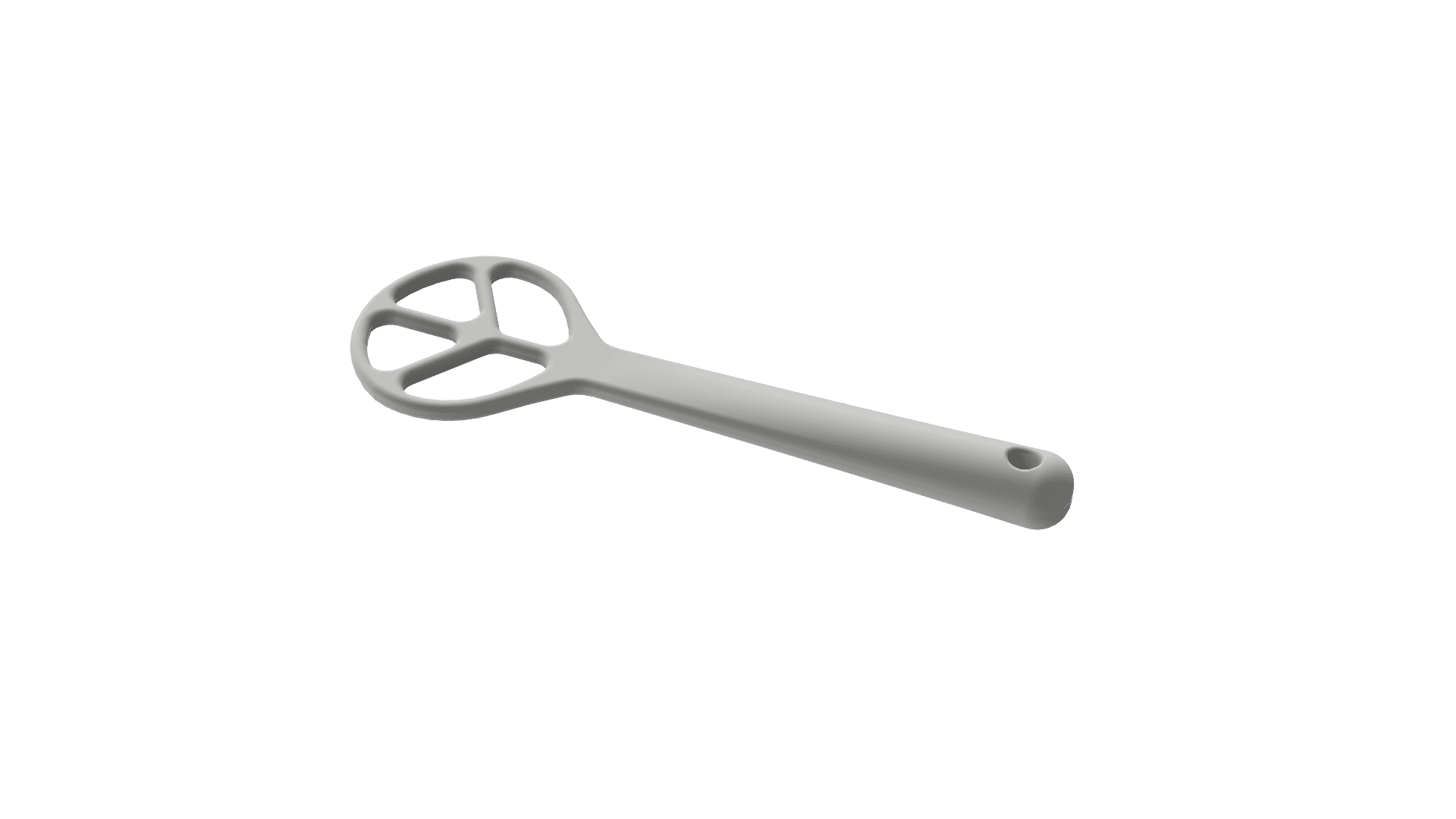
The Peace Dough Whisk has a flat, sculpted neck with G2 continuous curvature. In design, curvature continuity has grades. G0 is position continuity, two curves that meet but have a visible crease. G1 is tangent continuity, curves that meet smoothly but change direction. G2 is curvature continuity, curves that meet so smoothly there's no detectable change in radius. No crease. No corner. No place for dough to hide.
The ribs emerge tangentially. They begin at exactly the same angle as the curve they're leaving. No harsh intersections. No sharp angles where bacteria collect. Just one continuous, cleanable surface.
I also solved the mixing problem. The silicone surface at 58A Shore hardness is dense and grippy in a way that thin metal wires never can be. You can move flour. You can lift dough. You can scrape a bowl clean.
I chose food-grade silicone at 58A Shore specifically because it works. On the Shore scale from 0A (soft as butter) to 100A (car tire hard), 58A is firm enough to move dough without deforming, flexible enough to conform to bowl curves, and grippy enough to actually mix.
The handle is cylindrical with a subtle palm swell, round and ergonomic. But the neck transitions to something flatter, moving the weight forward and creating better leverage when you're pushing through thick dough.
Every choice answered one question: what does a whisk need to be if it respects both the person using it and their time? It needs to clean easily. Feel natural. Mix without fighting. Last for years.
My son doesn't care about G2 curvature or 58A Shore hardness. He just knows the whisk never breaks. That flour actually gets mixed. That it comes clean in one rinse.
Good design is quiet. It doesn't announce itself. It makes your life easier. It earns its place through respect, not flash.
That's why design matters. Not because it looks beautiful. But because it respects you.
More from the kitchen
Why I Built This (The Crevice Rant)
I'm holding a traditional whisk in my kitchen, and you know what I see? Dough. Dried, fermented dough tucked into every crevice. This is why Pure Peace Kitchen exists.
Breaking Up Shaggy Dough Without Losing Your Mind
Five minutes into mixing sourdough, you look down at your bowl and wonder if you've made a terrible mistake. You haven't. You've just started. Here's what nobody tells you about shaggy dough.